
| TL;DR Three outputs from one input set: break-even price, break-even ACoS, and minimum margin.Worked example: $5 COGS, $4 fees, $2 fulfillment gives a break-even price of $11.00. At $15 that is a 26.67% minimum margin.With no ad spend, break-even ACoS and minimum margin are the same number. They separate as soon as you advertise.Add $10 of PPC to a $25 product with $11 of base profit and break-even price moves to $24.A 15% coupon on a $30 product nets $25.50 and clears a $25 floor. A 20% coupon nets $24 and does not. Short version: the price floor is not a feeling about what feels too cheap, it is an arithmetic output, and every discount decision you make is a comparison against it whether you have calculated it or not. |
Nothing stops you from selling below cost. That is worth establishing at the start, because sellers sometimes assume some mechanism would object.
The method for working out where your own floor sits is set out in this Amazon break-even calculator guide. What follows is why the number has to come from you.
The Federal Trade Commission’s guidance on below-cost pricing addresses the antitrust question and answers it clearly: “Pricing below your own costs is also not a violation of the law unless it is part of a strategy to eliminate competitors, and when that strategy has a dangerous probability of creating a monopoly for the discounting firm so that it can raise prices far into the future and recoup its losses.” Its broader framing is that low prices generally benefit consumers, and that consumers are harmed “only if below-cost pricing allows a dominant competitor to knock its rivals out of the market and then raise prices to above-market levels for a substantial time.”
Which is the point. For a third-party seller with a normal share of a category, there is no external constraint on pricing below break-even. The marketplace will accept the listing, the discount will apply, and the sales will come in. The only thing standing between you and a profitable quarter is a number you calculated yourself.
One Input Set, Three Outputs
The same five inputs, price, cost of goods, Amazon fees, fulfillment and PPC budget, produce three different answers to three different questions.
Take a $15 product with $5 of cost of goods, $4 of Amazon fees and $2 of fulfillment.
| Metric | Formula | Worked |
| Break-even price | COGS + fees + fulfillment + PPC per unit | $5 + $4 + $2 + $0 = $11.00 |
| Break-even ACoS | ((price − COGS − fees − fulfillment) ÷ price) × 100 | (($15 − $5 − $4 − $2) ÷ $15) × 100 = 26.67% |
| Minimum margin | ((price − break-even price) ÷ price) × 100 | (($15 − $11) ÷ $15) × 100 = 26.67% |
Read them as a set. Break-even price answers “how low can I go.” Break-even ACoS answers “how much can I spend to acquire a sale.” Minimum margin answers “how much room do I have right now.”
Notice that the second and third come out identical at 26.67%, and that is not a coincidence or an error. With no ad spend in the model, the money available to buy a sale is exactly the money currently left over from a sale. They are the same quantity described twice.
They stop being the same the moment you advertise, and that separation is the whole reason to compute both. Put $2 per unit of ad spend into the model and the break-even price rises to $13.00, minimum margin falls to 13.33%, and break-even ACoS stays at 26.67% because it is defined before ads. One number is now telling you how much room you have and the other is telling you how much of it you are already spending.
All three respond to the same lever. Negotiate fifty cents off the unit cost and the floor drops, the ACoS ceiling rises and the room widens, all at once. That is why cost work outperforms bid work, and it does so quietly, without any campaign to monitor.
What Advertising Does to the Floor
Add PPC and the floor moves, sometimes a long way.
Take a $25 product with $7 of cost of goods, $4 of Amazon fees and $3 of fulfillment. Base profit before advertising is $11, a 44% margin, and it looks like a strong product.
Now spend $10 per unit acquiring the sale. Net profit is $1. And the break-even price is no longer $14, it is $7 + $4 + $3 + $10, which is $24, one dollar under the sticker.
That is the whole argument for treating advertising as a cost of goods rather than as marketing. At $10 of ad spend per unit, a $25 product has a dollar of room. Any discount at all, any fee increase, any return, and it is underwater, and none of that will be visible in a margin report that excludes ads.
The Coupon Test
The most useful thing a floor gives you is a yes or no on promotions, in about five seconds.
Regular price $30, break-even $25.
A 15% coupon takes $4.50 off, netting $25.50. That clears the floor by fifty cents. Thin, and it is profitable.
A 20% coupon takes $6.00 off, netting $24.00. That is a dollar below the floor, which means every redemption costs you a dollar and the promotion works exactly as well as the money you are giving away.
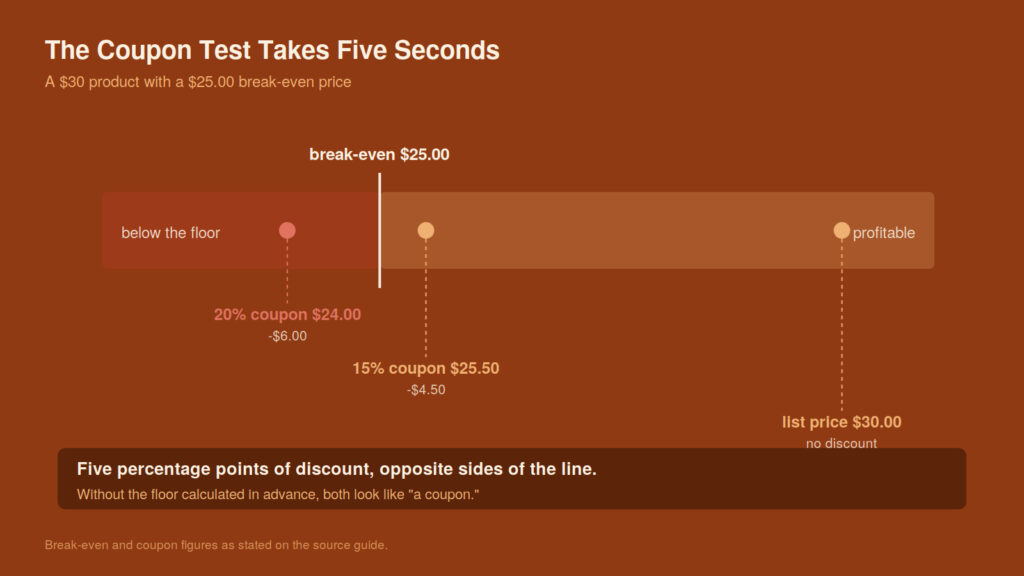
Five percentage points of discount, on opposite sides of the line.
Same product, five percentage points of difference, opposite sides of the line. Without the floor calculated in advance, both of those look like “a coupon.”
The Case Study Worth Copying
The destination page includes a supplement seller whose situation is common enough to be worth repeating.
Break-even ACoS of 25%. Long-tail campaign consistently running at 32%. Every sale from that campaign was losing money, and the campaign looked healthy because 32% ACoS sounds reasonable in isolation.
What they did is the interesting part. They did not cut bids or pause the campaign. They raised the price 5% and negotiated a bulk shipping discount, which lifted break-even ACoS from 25% to 30%.
Worth being precise about what that achieved, because it is often reported as a fix and it is not quite one. At 32% ACoS against a 30% break-even the campaign is still above the line. What changed is the size of the gap: seven points of loss became two, and two points is close enough that a modest bid adjustment or a small conversion improvement closes it, where seven was not.
That is still the better move. Bid reduction manages the campaign down to fit the product and costs you traffic. Raising break-even makes the product fit the campaign and keeps it. Do that first, then close the remaining two points with bids rather than trying to close all seven that way.
Three Places to Use the Number
Once you have the floor, it earns its keep in three specific decisions.
PPC bidding. Set target ACoS meaningfully below break-even, not at it. On the 26.67% break-even above, a target near 20% gives you a profitable campaign and 26.67% is the ceiling, not the goal. A target set at break-even is a campaign designed to make nothing.
Coupon planning. Compute the net price after discount and compare it to the floor before you approve the promotion, not after you review the month.
Repricing guardrails. If you use an automated repricer, the floor is the input it needs. A repricer without a correct floor will chase a competitor straight through your break-even, quickly and without asking, which is the single most expensive way to lose money on this platform.
Recalculate When the Inputs Move
The floor is not a constant. Fees change, freight changes, your ad cost per unit changes month to month.
Set the reminder quarterly, and set one additional trigger: recalculate immediately after any supplier price change, in either direction. A cost increase you have not put in the model is a floor that has already moved without you, and the discount you approve next week will be measured against a number that stopped being true.
About the Author