Cars, airplanes, air conditioning systems, batteries, and many other modern technologies depend on the movement of fluids to work properly. Engineers need to understand how air, water, and other fluids behave before creating or improving a design. However, studying fluid movement through physical testing alone can be expensive, time-consuming, and difficult. This is where computational fluid dynamics cfd software becomes useful. It allows engineers to study and predict fluid behavior using computer simulations instead of relying only on physical experiments.
Computational Fluid Dynamics (CFD) is a method that uses computer power, mathematics, and engineering principles to analyze how fluids move, transfer heat, and interact with different objects. It helps engineers make better design decisions by showing possible problems early in the development process. From improving aircraft designs to making cooling systems more efficient, CFD has become an important tool in many industries.
The History and Importance of Computational Fluid Dynamics
A Short History of CFD Development
The foundation of CFD comes from the Navier-Stokes equations, which describe how fluids move. These equations were developed in the 19th century and became the main mathematical basis for understanding fluid motion. However, solving these equations manually was extremely difficult because fluid behavior involves many changing factors.
As computers became more powerful during the 1950s and 1960s, researchers started using them to solve complex fluid problems. Scientists at the Los Alamos National Laboratory developed early computer methods to study fluid movement. Later, researchers such as John Hess, A.M.O. Smith, Brian Spalding, and Suhas V. Patankar helped improve CFD techniques and created methods that are still used today.
One important development was the SIMPLE Algorithm, which helped computers solve fluid flow problems more effectively. In 1981, the first commercial CFD software called PHOENICS was released, making CFD more available for engineers and companies. Today, CFD is widely used in industries such as aerospace, automotive, energy, electronics, and manufacturing.
Why Engineers Use CFD
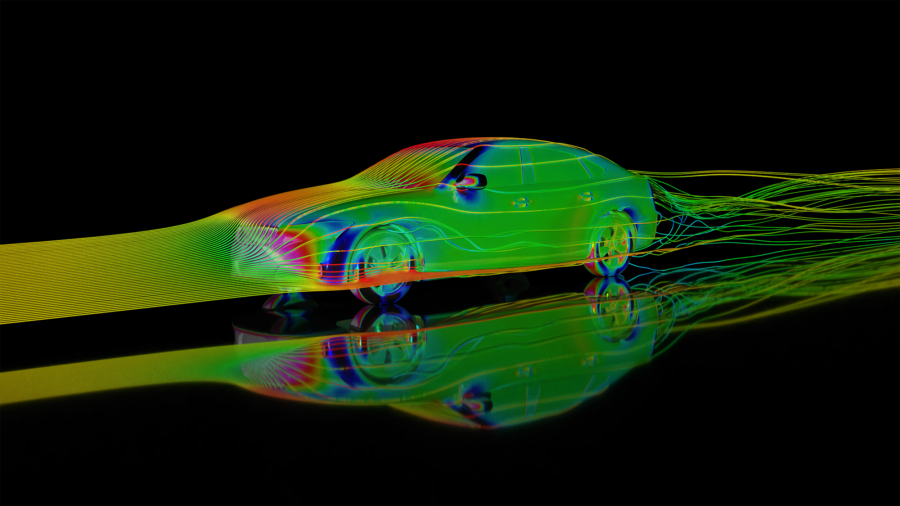
Fluid behavior affects many products and systems around us. For example, car companies use CFD to study airflow around vehicles and improve fuel efficiency. Aircraft manufacturers use it to understand air movement around wings and reduce drag. Engineers also use CFD to study cooling systems, pipelines, engines, and electronic devices.
The main advantage of CFD is that it allows engineers to test designs before building physical prototypes. Instead of creating many versions of a product and testing each one, engineers can use simulations to identify possible issues earlier. This helps reduce costs, saves time, and improves the final design.
CFD can provide information such as:
- Fluid speed and direction
- Pressure changes
- Temperature movement
- Heat transfer
- Forces acting on surfaces
These results help engineers understand how a product will perform under different conditions.
How CFD Works and the Science Behind It
Understanding the Navier-Stokes Equations
CFD is based on the Navier-Stokes equations, which describe the movement of fluids by applying the laws of motion and conservation. These equations explain how different forces affect fluid flow, including pressure forces, friction, and outside forces.
For CFD simulations, engineers often make certain assumptions to simplify the problem. Many simulations involve fluids that are:
- Newtonian fluids – fluids where viscosity stays consistent, like water
- Incompressible fluids – fluids where density does not change significantly
- Isothermal fluids – fluids where temperature remains constant
These assumptions make calculations easier while still providing accurate results for many engineering applications.
The Navier-Stokes equations are combined with the conservation of mass equation, which ensures that fluid entering and leaving an area is balanced. Together, these equations allow computers to predict how fluids behave inside a system.
Turbulence and Fluid Flow in CFD
One of the biggest challenges in CFD is predicting turbulence. Turbulence happens when fluid movement becomes irregular and changes quickly. A common example is the shaking movement felt during an airplane flight when the surrounding air becomes unstable.
Fluid flow can generally be divided into two types:
- Laminar flow – smooth and organized movement of fluid
- Turbulent flow – irregular movement with mixing and sudden changes
Engineers use the Reynolds number to determine whether a flow is likely to be smooth or turbulent. A low Reynolds number usually means laminar flow, while a high Reynolds number often indicates turbulent flow.
Because turbulence is very complex, CFD programs use different methods to estimate and study it. One of the most common approaches is the Reynolds-Averaged Navier-Stokes (RANS) model. This method simplifies turbulent flow calculations while still providing useful results for engineering designs.
The CFD Simulation Process
Before CFD software can solve a problem, engineers must first create a digital model of the area where the fluid will move. This model is divided into many small sections called cells. This process is known as meshing.
Each cell represents a small part of the fluid space. The computer then calculates fluid behavior in each section and combines the results to create a complete simulation.
The general CFD process includes:
- Creating a 3D model of the object or system
- Dividing the model into smaller cells
- Adding material properties and boundary conditions
- Choosing the correct simulation settings
- Running the calculation
- Reviewing the results through charts, graphs, and visual maps
CFD results are often shown through colorful images that display pressure, temperature, speed, and fluid movement. These visual results help engineers quickly identify areas that need improvement.
Final Thoughts
Computational Fluid Dynamics has changed the way engineers study and improve designs. Instead of depending only on physical testing, companies can now use computer simulations to understand fluid behavior faster and more efficiently.
Although CFD is a powerful tool, it still requires knowledge and experience to use correctly. The accuracy of results depends on the quality of the model, the chosen settings, and the understanding of fluid behavior. As computers continue to improve, CFD will continue to play a major role in creating safer, faster, and more efficient products in the future.
About the Author